biGENIUS-X expands its Microsoft Fabric support with 3 new Fabric Warehouse Generators, designed to simplify the implementation and operation of multi-layer, SQL-first data warehouse architectures on Microsoft Fabric.
Whether you are migrating from traditional SQL Server environments or building new data solutions with structured data, these generators provide a streamlined path to modern cloud data warehousing without the complexity of managing Spark infrastructure.
What’s new: 3 powerful generators for Microsoft Fabric data warehouse
The latest release introduces three specialized generators for Microsoft Fabric Warehouse:
- Data Store Generator: Foundation for staging and operational reporting
- Data Vault Generator: Automated core modeling based on Data Vault 2.0
- Data Mart Generator: Custom-built analytical layers for targeted business use cases
Together, these generators allow teams to implement a complete, layered Fabric Warehouse architecture using consistent patterns, rather than building and maintaining each layer manually.
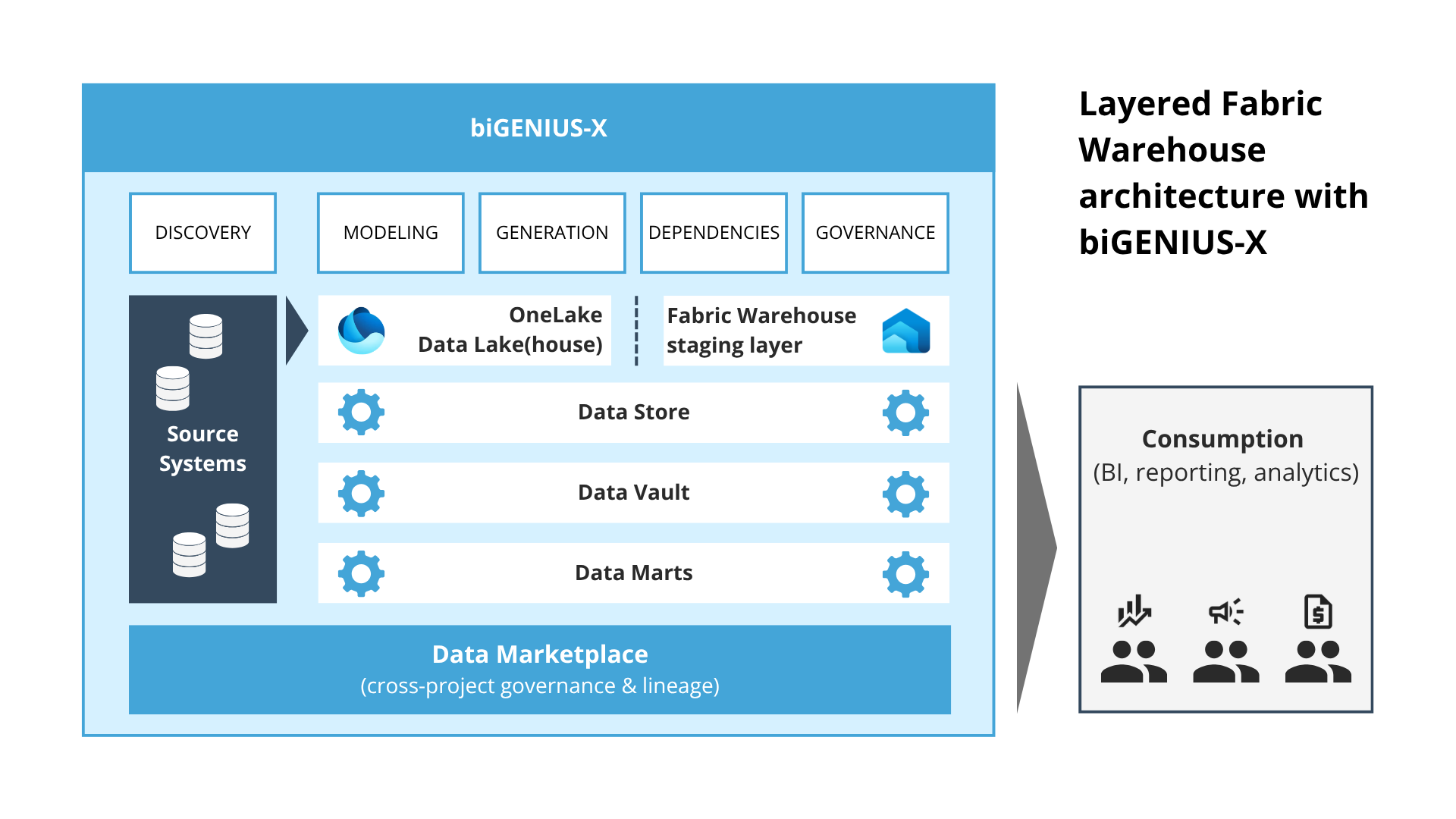
The new generators support the creation of data warehouse structures based on either a OneLake Data Lake(house) or an existing Fabric Warehouse staging layer. This allows teams to standardize their core warehouse architecture early, while retaining flexibility as platform usage and requirements evolve.
Why Fabric Warehouse? Key advantages over Lakehouse
While Microsoft Fabric’s Lakehouse architecture is well suited for large-scale and Spark-based workloads, Fabric Warehouse offers clear advantages for teams building SQL-first, structured data warehouses.
SQL-first development and migration simplicity
Fabric Warehouse accelerates cloud modernization by enabling the reuse of proven T-SQL logic and schemas from on-premises environments. For teams already proficient in T-SQL, this ensures a seamless transition into daily operations, as they can continue to build and manage data structures using their existing skill set. While some targeted refactoring is required to align with Fabric’s distributed architecture, the familiarity of the environment significantly reduces both migration risk and the long-term learning curve.
Transactional consistency and enterprise security
Fabric Warehouse supports multi-table ACID transactions, preserving data integrity across complex, multi-step operations. Combined with enterprise-grade security features such as Dynamic Data Masking (DDM), it meets the requirements of regulated and security-conscious environments without additional application-level controls.
Reduced operational overhead
By operating in a fully managed, SQL-first environment, Fabric Warehouse eliminates the need to provision, tune, and maintain Spark clusters. Built-in query optimization handles performance considerations automatically, allowing teams to focus on data modeling and delivery rather than infrastructure management.
These characteristics make Fabric Warehouse a strong foundation, but realizing its full potential still depends on how consistently and systematically the warehouse layers are designed, generated, and governed at scale.
Is Fabric Warehouse right for you?
While Fabric Warehouse offers compelling advantages, it is important to consider if it is the optimal choice for your business’s specific requirements. Fabric Warehouse would make sense for your organization if:
- Your team is already familiar with SQL or SQL Server technologies, including on-prem or Azure SQL environments
- You prefer a SQL-first approach and do not want to build or maintain Spark expertise
- You are building a traditional data warehouse with structured data
- You are managing enterprise data volumes but prefer a system that automates physical storage optimization (such as partitioning and file compaction) rather than requiring manual tuning and shard management
Example implementation with biGENIUS-X
Instead of viewing Fabric Warehouse merely as a destination for isolated tables, biGENIUS-X enables teams to systematically design and generate a complete, multi-layered architecture.
1. Data Store: the foundation layer
The data store serves as a stable, versioned repository for operational reporting and advanced analytics. biGENIUS-X generates code from metadata models to produce uniform structures and logic, allowing a single validated data asset to be reused across all downstream delivery layers.
2. Data Vault: historical integration
The Data Vault layer provides comprehensive historization of business entities and their relationships. By being built from a historically complete Data Store, this layer can be seamlessly re-generated whenever business rules or transformation logic evolve. This approach significantly simplifies development and ensures long-term maintainability at scale.
3. Data Marts: analytics-ready structures
Data Marts expose business-oriented, denormalized structures optimized for reporting and analytics. Depending on governance and team setup, they can be implemented within the same biGENIUS-X Project or as separate Projects, preserving lineage while supporting independent delivery cycles across teams.
4. Data Marketplace: governance and coordination
As Fabric Warehouse implementations grow across domains and teams, coordination becomes a challenge. The biGENIUS-X Data Marketplace provides centralized visibility into data products, source interfaces, lineage, and dependencies - ensuring governance keeps pace as the architecture evolves.
Conclusion: SQL-first data warehousing for the modern cloud
With the introduction of Fabric Warehouse Generators, biGENIUS-X makes Microsoft Fabric Warehouse a practical, scalable option for teams that want to modernize without abandoning proven data warehousing patterns. Instead of forcing a shift toward Spark-centric architectures, biGENIUS-X allows organizations to stay SQL-first while benefiting from Fabric’s managed cloud platform.
By generating data store, data vault, and data mart layers from shared metadata and governing them through the integrated Data Marketplace, biGENIUS-X provides a structured, low-risk path to Fabric adoption. Teams can standardize early, evolve incrementally, and scale across projects and domains -without increasing operational complexity or long-term maintenance effort.