Teams that standardize on dbt often decide on the tooling top-down; the data solution still must be built on it – model by model, schema file by schema file, by hand. At scale, that turns a dbt project into a consistency problem as much as a SQL one: one new business attribute touches several models, the YAML that describes them, and the documentation, and every file is another place to drift.
biGENIUS-X does not compete with that dbt decision, but completes it. You model the solution once in biGENIUS-X, and its dbt generator produces the project.
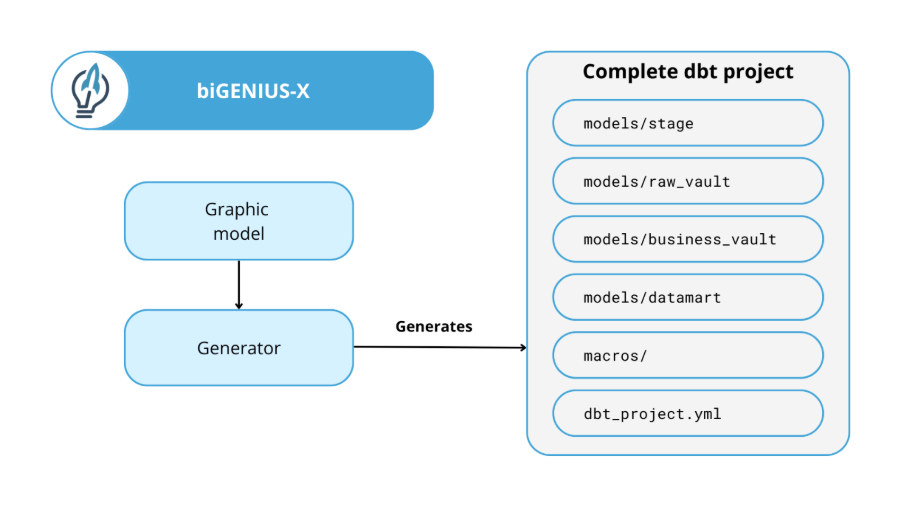
What the dbt Generator produces from one model
From a single graphical model, the generator produces a complete, runnable dbt project for Databricks:
- Stage – landing and prep
- Raw Vault – hubs, links, the satellite variants (multi-active, effectivity, record-tracking with delete detection), and PIT tables, with Current and History views on top as the consumer surface
- Business Vault – composites carrying business logic
- Datamart – SCD dimensions (types 0, 1, 2, and mixed) and facts
The Data Vault layer covers the object types teams work with – hubs, links, the satellite variants (multi-active, effectivity, record-tracking with delete detection), PIT tables, and the Current and History views that sit on top as a consumer surface. The datamart layer generates SCD dimensions (types 0, 1, 2, and mixed) and facts.
The result is a standard dbt project. It runs with the dbt tooling the team already uses, on the Databricks setup they already operate. One generation run of our sample project turned 119 model objects into 192 generated files, alongside the macros they call, source and schema YAML, and dbt_project.yml. dbt parse on the output returns a clean bill of health: zero errors.
The two layers dbt Data Vault libraries leave to you
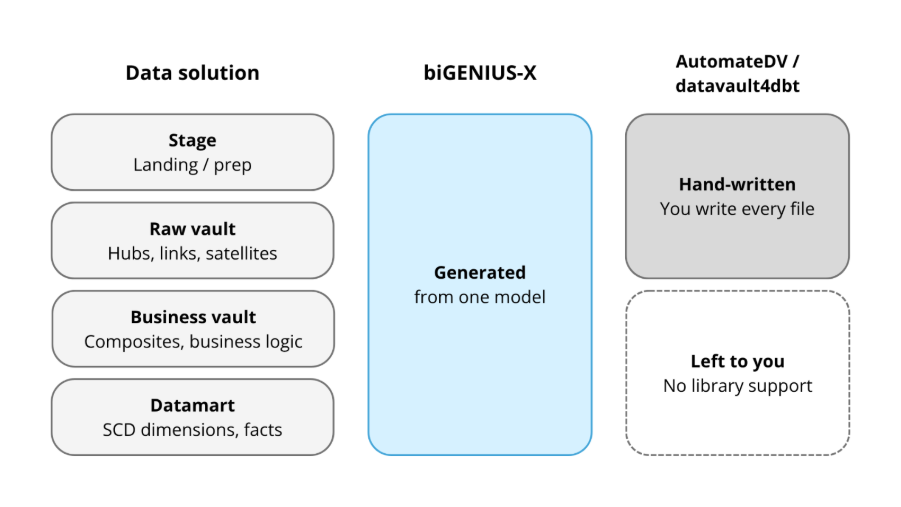
Most teams building Data Vault on dbt know AutomateDV or datavault4dbt, and many use them. Those libraries supply the building blocks — hubs, links, satellites, PIT tables — but the engineer still writes and wires every file by hand. biGENIUS-X generates all of it from the model instead.
The more significant difference is coverage. Both libraries stop at the Raw Vault. biGENIUS-X keeps going through two layers they don't touch: the Business Vault, where composites carry business logic, and the datamart, where the dimensions and facts your BI tools read get generated in the same project.
Code an engineer would have written by hand
The question anyone who writes dbt seriously will ask is what the generated SQL looks like. Hubs, links, and satellites load insert-only through an anti-join — a LEFT JOIN against the target that keeps only rows not yet loaded. That is the same pattern AutomateDV and datavault4dbt use, so the generator follows what the dbt Data Vault community treats as correct rather than inventing its own loading logic.
The load patterns ship as custom Databricks materializations inside the generated project, so there is no external package to install. Schema-drift tolerance is built into every model: on each run the models reconcile columns, table properties, partitioning, and clustering against the live table, so the project keeps running when the environment moves. Contracts are enforced at build time, and key constraints are declared for the catalog.
One default is worth calling out, because it looks like a contradiction of insert-only loading. Insert-only usually means ValidTo is not stored — it is computed at read time with a window function. The generator supports that, but defaults to persisting ValidTo: a MERGE post-hook closes the previous version right after the insert. The load stays an insert; the single update is confined to that post-hook. In return, ValidTo becomes a real column that liquid clustering can use, so time-slice queries prune files instead of scanning full history. Teams that prefer read-time computation can switch back.
The project is the client's, with no runtime dependency
What the generator produces belongs to the client, without restriction: readable SQL models plus the macros they call, all generated into the project. There is no dependency on a third-party macro package and no biGENIUS-X runtime — cancel the tool and the project keeps running. Project metadata lives in the client's own Git repository, which we have no access to unless they grant it.
Added an attribute? Just regenerate the project
The case for model-driven work shows up six months in, when someone adds a new segment attribute. In a hand-written project, that means finding every affected model, editing the schema YAML, and trusting that documentation and lineage keep pace.
With biGENIUS-X, it means changing the model and generating again. Every file comes out consistent because every file comes from one source:
- Descriptions land in Unity Catalog through persist_docs,
- Sensitivity tags travel with the model, and
- Object- and attribute-level lineage shows what a change touches before anything runs.
The model outlives platform strategy
dbt is only one of the target technologies that biGENIUS-X supports. With biGENIUS-X, users can generate native code for other platforms – Microsoft Fabric, SQL Server, Snowflake, Oracle, and PySpark – from the same model. The investment lives in the model, not in the hand-written code of one platform: if the platform strategy changes, organizations can generate again instead of rebuilding from scratch.
See what it generates for a model like yours
If you run dbt on Databricks, the fastest way to judge the output is to generate it. Start a free trial or book a personalized demo to see how easy it just is.