The task
We asked an AI agent to build a data warehouse for the Willibald challenge of the DDVUG, the German-Speaking Data Vault User Group. The challenge gives every participant the same sales data from a web shop and roadshows, delivered in three periods.
The data contains typical real-world problems, such as a customer entry that is deleted but later recovered. These feed 13 loading challenges, plus tasks for the Business Vault and the data mart and a set of cross-cutting criteria. Eight tools have taken the challenge so far, and their solutions are documented on dwa-compare.info. biGENIUS-X is the ninth.
We did two runs to fulfill the challenge:
- With the AI agent alone, in this case Claude Code.
- With the same agent, connected to biGENIUS-X through our MCP server. (biGENIUS-X users can download our Claude plugin)
Both runs got the same brief, the same source data and the same reviewer. The target: 24 expected report figures.
Run 1: the AI agent alone
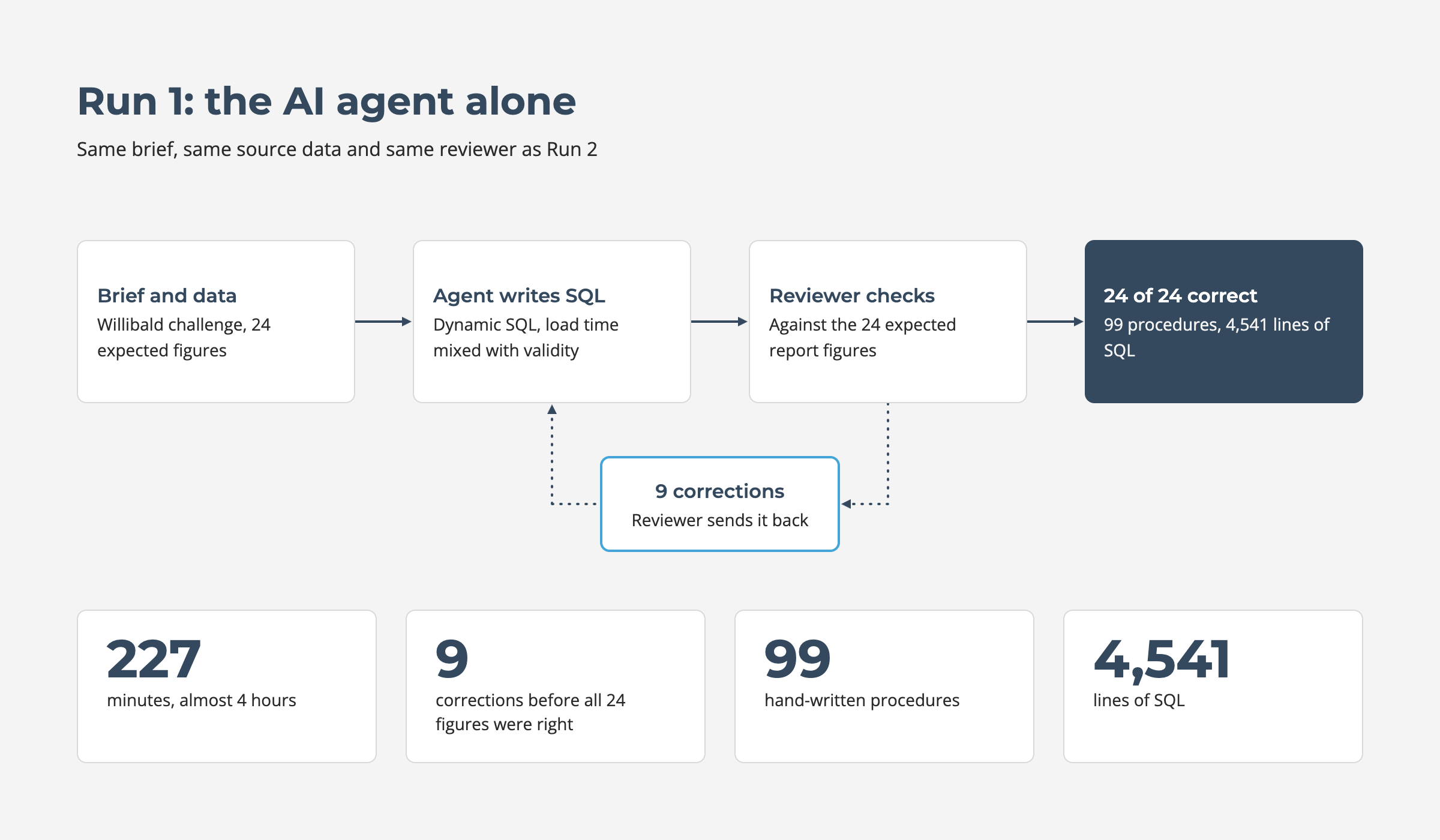
Without a modeling framework, the agent wrote the SQL itself and needed almost 4 hours (227 minutes).
The first version used dynamic SQL and mixed load time with validity. Our reviewer had to correct nint things before all 24 figures were right. The result: 99 hand-written procedures with 4,541 lines of SQL.
There is no model to look at, so anyone who wants to understand or change the warehouse has to read it out of the code, and every change means editing the affected procedures by hand.
Run 2: the same AI agent with biGENIUS-X
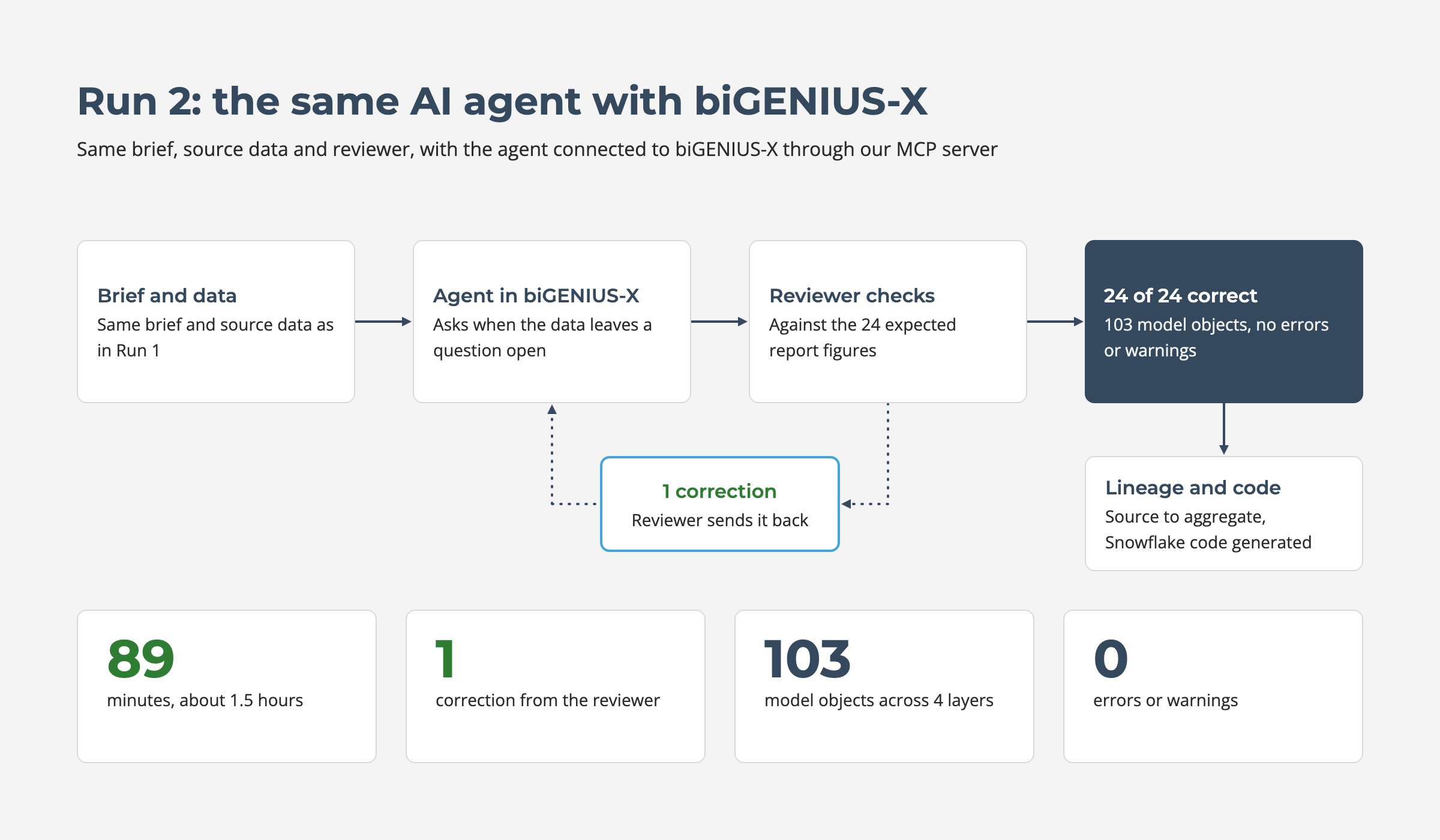
We connected the agent to biGENIUS-X through our MCP server and gave it the same brief as run 1. The agent modeled the data warehouse inside biGENIUS-X, following our application's modeling rules.
After about 1.5 hour (89 minutes) the result was ready, and all 24 figures were correct: 103 model objects across Stage, Raw Vault, Business Vault and Mart, validated without errors or warnings, with one correction from our reviewer along the way.
One moment mattered to us: when the source data left a question open, the agent asked instead of guessing; in another test we did with our Black Forest Markets sample data, it asked which column should define the product group, and offered the options to choose from.
The finished model came with full lineage from source to aggregate, and biGENIUS-X generated the code for Snowflake as it always does.
What made the difference
While running this task using agentic modeling with biGENIUS-X presented a visible advantage in speed, the more important difference is what the agent was working on.
In the first run, the agent did everything, including writing the code. In the second, it worked on the model, and the biGENIUS-X generator wrote the code.
Both runs had a first version at about the same time, the gap opened in the rework. Most of what our reviewer had to correct in the first run were things the biGENIUS-X generator would have settled, such as loading patterns, time handling and hash keys. Ultimately, we had the following fundamental differences in run 2:
Rules
The agent follows our modeling rules, so the structure is consistent and follows best practice.
Generated code
The code is standardized and maintainable, not improvised.
Control
The agent asks before it guesses, validates its work, and every object has lineage.
What this means for your team
AI Agents can work fast, but speed is not the same as production-ready. In our test, using the AI agent with biGENIUS-X reached the correct figures in less than half the time as with the agent alone, and also needed about a quarter of our reviewer's time in run 1. With biGENIUS-X agentic data modeling, you can get AI agent speed with the quality and maintainability you expect from biGENIUS-X.
Current tested and supported agents
- Claude Code
- OpenAI Codex
- GitHub Copilot
Early access
Sign up for early access to see agentic data modeling in action.